Preview image. Unlock full-res
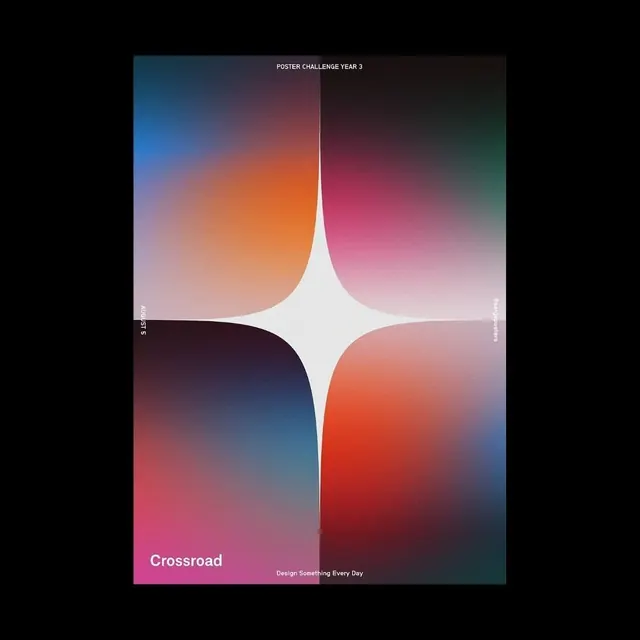
Design challenge poster with four smooth radial gradients (cool to warm, blue to pink to orange to teal) meeting at a white four-curved center motif, labeled 'Crossroad.
Summary
Design challenge poster with four smooth radial gradients (cool to warm, blue to pink to orange to teal) meeting at a white four-curved center motif, labeled "Crossroad."
Visual description
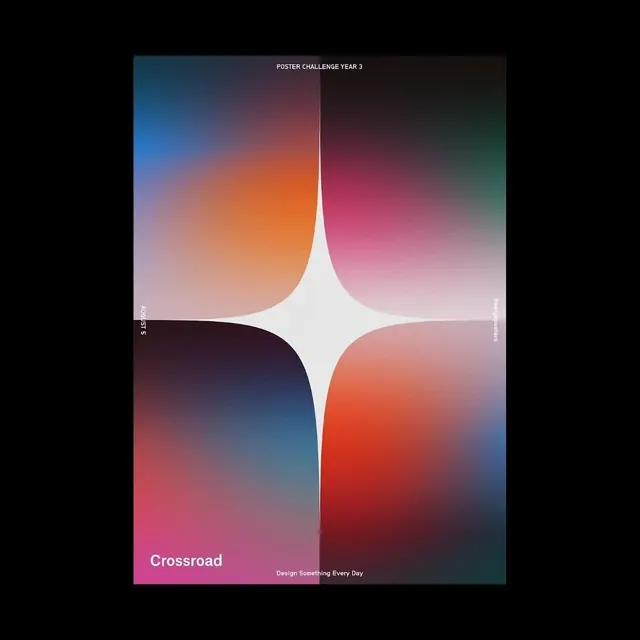
A square poster divided into four quadrants by a white four-lobed curve shape anchored at the center. Each quadrant contains a smooth radial gradient flowing from the white center outward: top-left blue to pink, top-right orange to pink, bottom-left blue to burgundy, bottom-right orange to red. The gradients are seamless and appear to radiate from the center rather than corner-to-corner. Headline "POSTER CHALLENGE YEAR 3" sits centered at top in small white caps. "Crossroad" appears in large sans-serif (likely geometric display type) in white at bottom-left. "Design Something Every Day" tagline in white caps at bottom-right. Vertical text along left and right edges reads "YEAR 3" and "DESIGN." Black background fills the outer frame.
Key takeaway
Smooth radial gradients radiating from a center point create dimensional depth and visual pull. The white curved shape at the axis acts as both a focal point and a visual rest. The four-color transition feels balanced despite using both warm and cool hues because each quadrant contains a complete warm-to-cool range. Minimal type placement (headline, title, tagline) allows the gradient composition to dominate.
Reuse notes
Effective for poster design, design-school briefs, or any context celebrating color and geometric abstraction. The radial approach works best as a square or near-square format. Readable at small sizes despite the bold color transitions. Not suitable for minimal or corporate applications. Works well printed at large scale where the gradient smoothness becomes a tactile reference.
More like this




Keep what you find
A free account saves references to boards and can send you a weekly email of picks based on what you save.
To see every result, go Pro.