Preview image. Unlock full-res
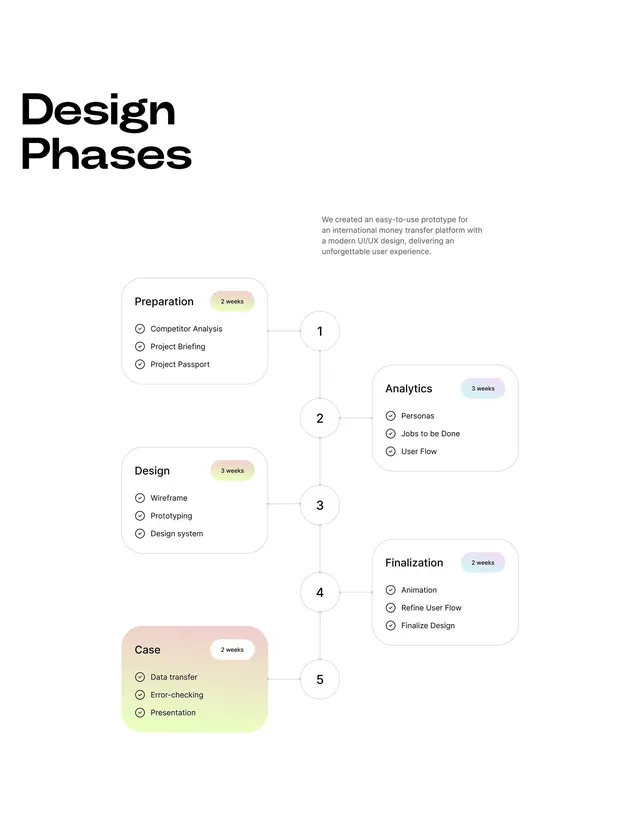
Vertical flowchart mapping a design workflow across five numbered phases (Preparation, Analytics, Design, Finalization, Case) with tasks and week-duration badges.
Summary
Vertical flowchart mapping a design workflow across five numbered phases (Preparation, Analytics, Design, Finalization, Case) with tasks and week-duration badges.
Visual description
Left-aligned diagram with "Design Phases" as the main headline in bold black sans-serif. Below, a brief description text explains the project context (international money transfer platform prototype). The flowchart occupies the right side, with five phases arranged vertically on the left, each in a soft rounded-rectangle container with a distinct pastel background (light gray, light purple, light yellow, light purple, light green). Each phase lists 2-3 bulleted tasks in clean sans-serif with circular checkmark icons. Pastel colored duration pills (2 weeks, 3 weeks, etc.) sit top-right of each phase. A central vertical connector line links five numbered circles (1-5), positioned to the right of the containers, establishing clear visual flow. Right-side metadata boxes ("Analytics", "Finalization") duplicate key information with their own task lists and duration badges, reinforcing the sequential structure. White background with minimal borders creates a clean, approachable information hierarchy.
Key takeaway
The phase+task+duration structure makes abstract process concrete and assignable. Circular connectors linked to numbered phases create unambiguous sequence without arrows. Pastel background colors distinguish phases while maintaining cohesion. The two-column layout (tasks left, metadata right) prevents visual clutter while letting both content and workflow coexist. Small task lists under each phase are scannable and actionable.
Reuse notes
Ideal for design proposals, UX documentation, project kickoffs, and team onboarding where process clarity matters. The soft palette conveys accessibility and reduces intimidation factor for non-designers. Use this style when phases must be equal-weight and sequential. Best suited to 4-6 phase workflows; beyond that, consider nesting sub-phases. Works well for both client-facing decks and internal team documentation.
More like this

Keep what you find
A free account saves references to boards and can send you a weekly email of picks based on what you save.
To see every result, go Pro.