Preview image. Unlock full-res
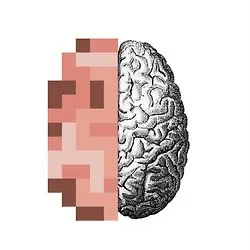
A vertically split brain motif: the left half dissolves into pink-and-terracotta pixel blocks while the right half is a detailed black-and-white engraving, on white.
Summary
A human brain split down the middle: the left hemisphere breaks into a blocky pixel grid in pinks and terracotta, while the right hemisphere is rendered as a fine black-and-white anatomical engraving, set on plain white.
Visual description
The two halves meet along the brain's natural central fissure so they read as one organ despite opposite visual languages. The left side is reduced to chunky square pixels stepping through dusty rose, salmon, and brown, an intentionally low-resolution, digital treatment. The right side is a high-detail vintage engraving, every gyrus and sulcus drawn in tight hatched line, fully analog. White negative space surrounds the shape with no type, frame, or other element, so the contrast of the two rendering styles is the entire idea.
Key takeaway
Cut a single recognizable subject down the middle and render each half in an opposing technique, pixel grid versus fine engraving, to dramatize a concept like human-versus-machine or analog-versus-digital in one image. Aligning the split with the object's own symmetry axis keeps it legible as one thing.
Reuse notes
Ideal for biotech, neuroscience, cognitive-AI, or mental-health brands needing a conceptual mark or editorial illustration. The device generalizes to any symmetric subject. Keep one half restrained so the contrast stays a clear binary rather than visual noise; the warm pixel palette here keeps the tech side from feeling cold.