Preview image. Unlock full-res
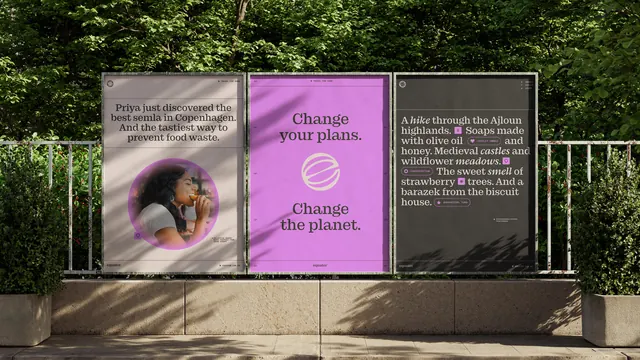
Three posters in a hedge-backed street display show the range of one system: a photo-and-copy blush poster, a magenta monogram poster and a dark long-copy poster.
More like this
See all

Summary
Three portrait posters side by side in an outdoor display case, each using the same header and footer rules but a different balance of image, monogram and copy.
Visual description
The display sits on a low stone plinth in front of a metal railing and a dense green hedge, with dappled shadow falling across the glass. Every poster shares a thin rule near the top and bottom with tiny letterspaced caps in the margins and the "equator" wordmark bottom left. The left poster is warm blush grey: three lines of serif copy at the top about discovering the best semla in Copenhagen and preventing food waste, then a large circular photograph of a woman eating a pastry, masked into a magenta ring, with a small magenta map-pin chip at its lower left. The center poster is flat magenta with only three elements: "Change your plans." above and "Change the planet." below, both centered in near-black serif, and a cream globe monogram with a swept diagonal band between them. The right poster is dark olive grey with cream serif copy filling most of the field, mixing roman and italic on words like "hike", "castles", "meadows" and "smell", with small magenta chips and outlined pill labels reading "LOCALLY OWNED", "CONSERVATION" and "SUPPORTING JOBS" set inline. Its footer carries a line of tiny caps.
Key takeaway
One frame proving a system has range: a photo-led poster, a pure monogram poster and a copy-led poster hold together because the header and footer rules, the serif, and the magenta annotation chips never change. Inverting the third panel to a dark ground is what stops the row from reading as three versions of the same poster.
Reuse notes
Useful for planning an out-of-home or print campaign that needs several message types, and as a template for how to present a poster series in a case study. The circular photo mask and inline pill labels both need generous poster scale. The dark panel's cream-on-olive copy is the lowest contrast of the three, so check it against real ambient light before committing.