Preview image. Unlock full-res
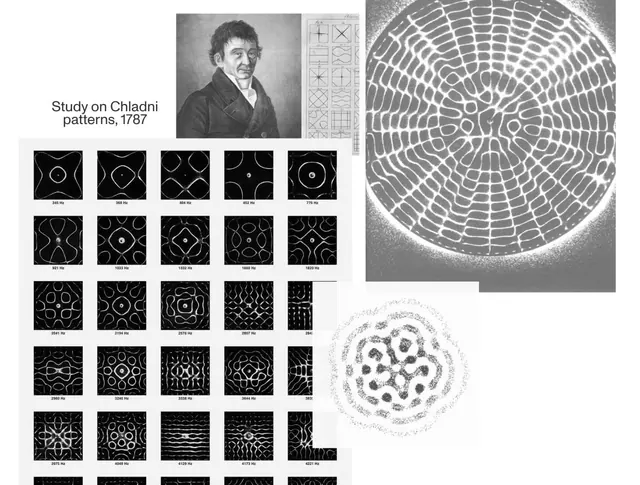
A historical 1787 scientific plate documenting Chladni nodal patterns: a portrait of Ernst Chladni, geometric pattern sketches, and a grid of twenty-five black-and-white resonance visualizations.
Summary
A historical 1787 scientific plate documenting Chladni nodal patterns: a portrait of Ernst Chladni, geometric pattern sketches, and a grid of twenty-five black-and-white resonance visualizations.
Visual description
The composition is divided into three zones. Top left: a period portrait of Ernst Chladni in dark formal attire. Center-left: a vertical strip of geometric line sketches showing pattern variations. Left side: a five-by-five grid of monochrome square panels, each labeled with a numerical identifier, displaying distinct symmetric patterns made of white lines on pure black. Right side: two large circular resonance pattern diagrams rendered in grayscale with radiating web-like structures and varying line densities. The entire plate uses only black, white, and gray tones, printed on off-white paper. Typography is minimal and functional.
Key takeaway
The elegant grid-and-study format that combines portraiture, conceptual sketches, and systematic documentation into one cohesive visual narrative. Each pattern variation reads as distinct despite the monochromatic palette, demonstrating how line weight, symmetry, and spacing alone convey complexity. The large circular patterns provide visual relief and scientific weight to the smaller square studies.
Reuse notes
Ideal for educational materials, scientific posters, or editorial layouts celebrating research and precision. The monochrome treatment lends historical authority and timelessness. Scale well: works as a large-format reference and at small sizes. Pair with sans-serif, mathematical type. Avoid colorization, which would diminish the academic legitimacy.
More like this

Keep what you find
A free account saves references to boards and can send you a weekly email of picks based on what you save.
To see every result, go Pro.