Preview image. Unlock full-res
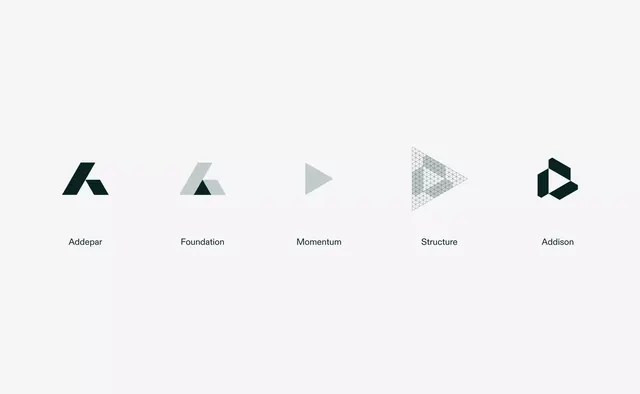
A logo-exploration presentation showing five named geometric marks from a simple folded A to a textured play-triangle to a 3D hexagon, in dark teal on pale gray.
Summary
A logo-exploration slide displaying five named concepts in left-to-right progression from a simple folded A mark through increasingly complex geometric variations, all in dark teal on off-white.
Visual description
Horizontal presentation slide on pale gray background. Five abstract marks sit in a single centered row, each labeled below in quiet dark sans-serif. From left to right: Addepar shows a solid two-plane folded A in dark teal. Foundation shows the same A split into two-tone (light and dark teal) planes. Momentum presents a flat right-pointing triangle reading as a play-button in medium gray. Structure overlays that same triangle with a fine isometric grid pattern revealing the construction geometry underneath. Addison transforms the play-triangle into a faceted 3D hexagon or cube-like solid in dark teal. The progression demonstrates how one core geometric primitive (the triangle) evolves through five named concepts without breaking family resemblance. Heavy white space above and below each mark isolates them like a gallery wall.
Key takeaway
Showing a logo evolution left-to-right, simple to complex, with a visible construction grid on one variant, communicates systematic thinking and justifies the design process to a client. Anchoring all five marks to a single triangle primitive and reusing the play-button geometry across multiple concepts proves the marks belong to one family while showing range and versatility.
Reuse notes
A layout template for logo-exploration or brand-pitch decks, especially for fintech, B2B, or tech platforms pursuing a geometric mark language. The monochrome treatment ensures attention stays on form and construction; reserve color introduction for later rounds or secondary applications. The presentation rhythm (simple to complex, single primitive reused) works for any geometric system.
More like this
Keep what you find
A free account saves references to boards and can send you a weekly email of picks based on what you save.
To see every result, go Pro.