Preview image. Unlock full-res
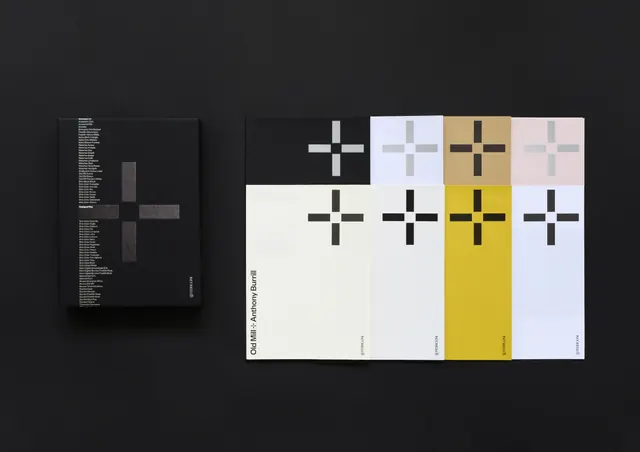
Swiss-style identity system featuring modular geometric crosses rendered in a grid across multiple color backgrounds and a dark typographic cover.
Summary
Design system showing a modular geometric cross mark applied across a palette of carefully controlled backgrounds, with a dense typographic manual on the left.
Visual description
Left side: dark charcoal-black printed manual cover with tight columnar type (small sans-serif, white); includes two rectangular color swatches (gray and tan) positioned vertically, suggesting material samples or color reference. Right side: 8-unit grid (2x4) displaying the core cross symbol in various configurations. Crosses rendered in bold geometric form (equal-weight perpendicular strokes) appear in charcoal, white, mustard yellow, and pale blue. Each cross is centered within a colored square or rectangular field (light cream, pale blue, mustard yellow, pale pink, white); proportional spacing around each mark. Typography on right edge (small caps, monospace) labels each swatch. The system demonstrates mark consistency and color harmony within a restrained, austere palette.
Key takeaway
The modular cross as a primary brand mark that scales and adapts to color contexts without loss of recognition. The systematic presentation (grid, labels, color fields) communicates the mark's flexibility. Using carefully modulated neutral and accent colors (cream, pale blue, mustard) rather than saturated primaries creates sophistication and restraint.
Reuse notes
Excellent model for media, publishing, or cultural-institution identities where geometric marks need versatility across backgrounds. The manual format itself is a reference: showing the mark in context with actual color samples builds confidence in production. The cross's symmetry and simplicity ensures legibility at any size; the grid presentation is ideal for brand guidelines or identity standards documentation.
More like this

Keep what you find
A free account saves references to boards and can send you a weekly email of picks based on what you save.
To see every result, go Pro.