Preview image. Unlock full-res
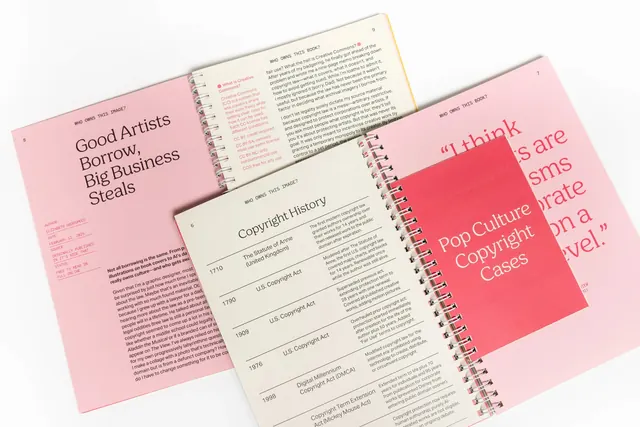
Spiral-bound publication set with pink and beige covers featuring structured typography and a copyright history timeline, demonstrating editorial branding for academic content.
Summary
Three spiral-bound notebooks fanned open, with coral and beige covers printed with serif display type and documentation pages, showcasing editorial restraint and historical reference layout.
Visual description
Three spiral-bound publications arranged in an overlapping fan composition. Left notebook has a coral pink cover printed with "Good Artists Borrow, Big Business Steals" in large serif type. Center pages display a copyright history timeline with structured rows of legal milestones (U.S. Copyright Act entries dated 1790, 1870, 1976, etc.) set in small sans-serif capitals with justified text blocks. Right notebook is solid bright coral pink with partial text visible. The cream-colored center notebook shows detailed copyright documentation. All typography is justified and precisely aligned, emphasizing structure and information density. Binding hardware and page edges are visible, showing the physical print artifact.
Key takeaway
The composition of stacked, offset printed publications creates visual depth and tells a story of editorial restraint. Using a restricted palette of warm pinks and creams paired with black serif and sans-serif type creates impact without decoration. A timeline layout with consistent row height and grid-aligned type demonstrates how to make complex historical information scannable and elegant.
Reuse notes
Strong for book, publication, and editorial branding. The spiral binding and visible pages communicate craftsmanship and substance. Works well for legal, academic, or archival subjects where precision and documentation are part of the brand story. Consider for product packaging or identity systems that benefit from a tactile, information-forward approach.
More like this

Keep what you find
A free account saves references to boards and can send you a weekly email of picks based on what you save.
To see every result, go Pro.