Preview image. Unlock full-res
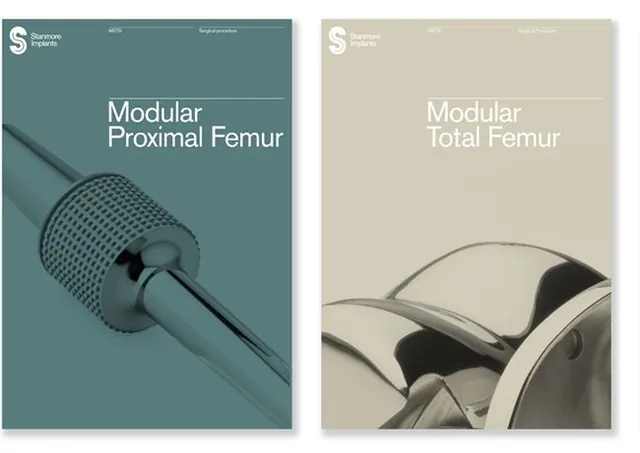
Two-panel product branding for Stryker medical implants, using muted teal and cream backgrounds with 3D product photography and minimal sans-serif titling.
Summary
Two-panel product branding for Stryker medical implants, using muted teal and cream backgrounds with 3D product photography and minimal sans-serif titling.
Visual description
Left panel: teal background (muted blue-green) with Stryker branding at top and title "Modular Proximal Femur" in light-weight sans-serif. Below, a close-up photograph of a threaded cylindrical implant rendered in grayscale, photographed at an angle to show textural detail and depth. Right panel: cream-beige background with matching Stryker branding and title "Modular Total Femur." Below, a curved orthopedic implant component photographed with soft lighting against negative space, showing contours and mechanical articulation points. Both images use professional product photography with careful lighting to emphasize surface quality and precision engineering. The overall composition is symmetrical, institutional, and conveys clinical precision through minimal typography, muted color separation, and high-quality 3D product rendering.
Key takeaway
The color-blocking approach (distinct background per product) creates visual separation and hierarchy while maintaining overall cohesion. The product photography style (clean, well-lit, detail-focused) establishes trustworthiness and precision without requiring elaborate stylization. Light sans-serif typography against colored backgrounds ensures legibility and conveys modernity in a clinical context.
Reuse notes
Ideal for medical device, orthopedic, surgical, or healthcare-equipment companies. The teal-and-cream palette is calming and institutional. Best when paired with high-quality product photography and restrained typography. The approach works across marketing materials, packaging, and digital applications. Requires access to professional product shots; works less well with commoditized or generic product imagery.