Preview image. Unlock full-res
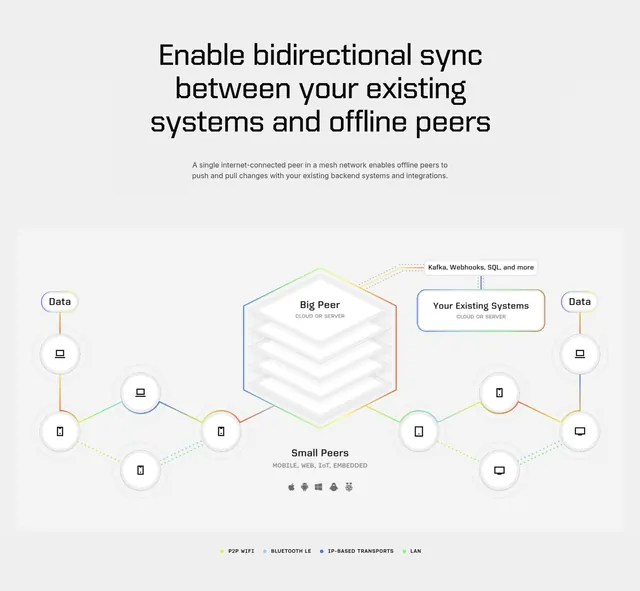
Light feature section with a centered headline above a large rounded architecture diagram of cloud, big peer, and small peers.
Summary
A light, centered feature-detail section that explains bidirectional sync through one large architecture diagram connecting a cloud big-peer, existing systems, and a fan of small peers.
Visual description
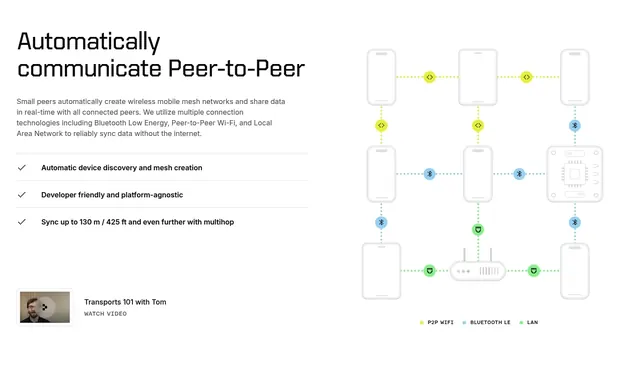
Light grey background. A centered three-line headline "Enable bidirectional sync between your existing systems and offline peers" sits in a wide technical display face above two muted lines of supporting copy. Below, a large rounded light-grey panel contains the diagram: a central layered hexagon labeled "Big Peer / CLOUD OR SERVER", a rounded "Your Existing Systems / CLOUD OR SERVER" callout to its right linked by a dotted "Kafka, Webhooks, SQL, and more" tooltip, and two "Data" pills on the outer edges. Below stretches a row of circular device nodes labeled "Small Peers / MOBILE, WEB, IoT, EMBEDDED" with Apple, Android, Windows, and other platform glyphs. All nodes are wired together with soft rainbow-gradient connector lines, and a bottom legend maps colors to P2P WiFi, Bluetooth LE, IP-based transports, and LAN.
Key takeaway
Carrying the entire explanation in a single well-composed architecture diagram, with the headline doing the talking and the panel doing the showing. The rainbow-gradient connectors plus a legend turn a dense systems diagram into something approachable rather than intimidating.
Reuse notes
Use when the product's value is its place in a larger data/sync architecture and a diagram communicates faster than paragraphs. The diagram is complex, so it needs room and clean rendering; it suits a developer or data-infrastructure audience. The centered headline keeps the focus on the visual beneath it.
More feature detail sections
See all








More like this




Keep what you find
A free account saves references to boards and can send you a weekly email of picks based on what you save.
To see every result, go Pro.