Preview image. Unlock full-res
Street billboard for SWBID tiling the line "What Community Can Be" across a grid of green, yellow, red, and blue blocks interleaved with line-drawn neighborhood icons.
More like this
See all
Summary
A billboard whose message is assembled from a modular grid of colored blocks, with every other cell given over to a line-drawn icon of street furniture and planting.
Visual description
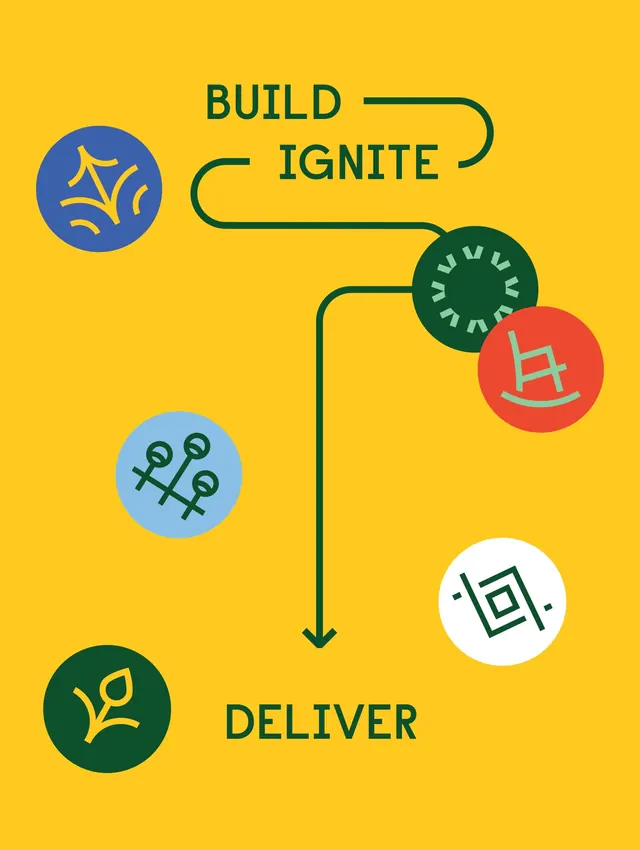
The board hangs in a slim aluminium frame on a pale plaster wall, lit hard from the right so it throws a soft shadow. A woman in a red cap, dark jacket, and orange trousers walks past at the right, motion-blurred against grey paving. Inside the frame, pasted sheets form a three-row grid of rectangles in dark green, mustard yellow, mint, cornflower blue, and tomato red. The headline runs across it in wide tracked caps, broken by row: "WHAT" in pale blue on dark green, "COMMUNITY" in dark green on cornflower blue spanning three cells, and "CAN BE" in pale blue on dark green. The remaining cells hold single-weight line icons drawn in green or yellow: a row of lollipop street trees on yellow, a tulip-like plant on mint, two starburst sun or flower marks on mint, a small square spiral on red, a rocking chair outline on red, a fan-shaped tree on yellow, and an arched bridge or pergola on yellow. The top-right cell is dark green with the URL "swbidpartnership.org" repeated on five tightly stacked blue lines. Creases and seams in the pasted paper are visible.
Key takeaway
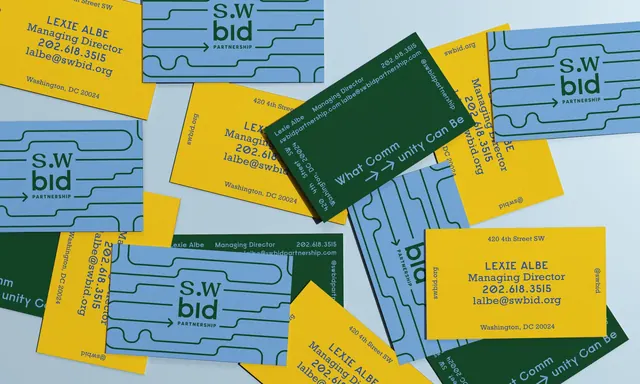
Setting a headline into a color-block grid instead of over a background lets the message and the icon library share one layout system, so the same grid scales from a business card to a billboard. Repeating the URL five times turns a legal necessity into a texture block.
Reuse notes
Strong reference for neighborhood, district, and civic identities that need warmth without photography. The icon set has to be drawn at one stroke weight or the grid falls apart, and the palette relies on the deep green as an anchor for the brighter cells. Tracked-out caps at this size need generous cell padding to stay readable from across a street.