Preview image. Unlock full-res
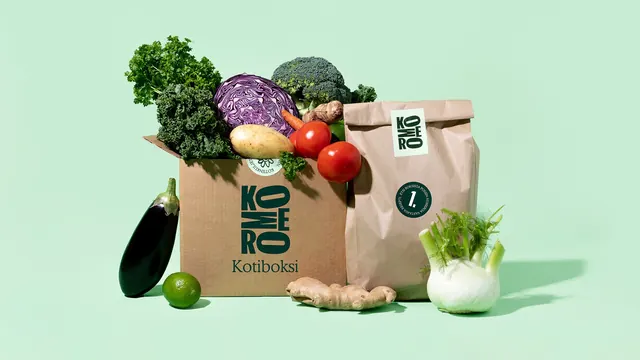
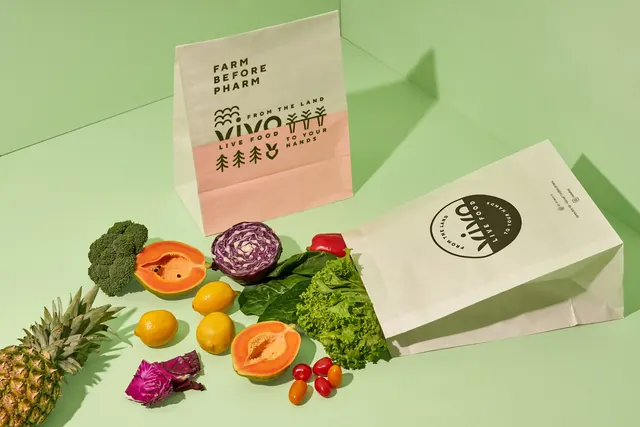
An unbleached cardboard delivery box overflowing with vegetables next to a kraft paper bag, both branded with only a stamped dark green wordmark.
More like this
See all
Summary
The delivery end of the range shown in raw kraft board and paper, where the identity is reduced to a single stamped wordmark plus small stickers.
Visual description
A corrugated kraft box sits open on a mint green sweep, packed so full that parsley, curly kale, halved red cabbage, broccoli, a potato, a carrot, ginger and tomatoes on the vine spill over its front edge. The box front carries the stacked condensed wordmark printed in dark green directly on the brown board, with a lighter serif word for the home-box sub-name set on a single line beneath it. A small pale mint circular sticker with a flower icon is stuck at an angle on the top flap. To the right stands a kraft paper bag with a rolled top, branded by a pale mint rectangular label patch bearing the same stacked wordmark, plus a solid dark green circular seal lower down carrying a large numeral one ringed by curved small-caps copy. An aubergine, a lime, a knob of ginger and a whole fennel bulb are arranged on the surface around the two packs, all lit softly from the front left with long shadows falling to the right.
Key takeaway
Printing straight onto unbleached board and letting the mint show up only as small stickers and label patches makes the delivery packaging read as the low-effort, low-waste tier of the same system. The numbered seal turns the bag into a step in a sequence rather than a container.
Reuse notes
Reach for this when a food brand needs a home-delivery or subscription format that visibly costs less than its retail packs without leaving the family. The single-colour print survives on rough board; a lighter mint or a gradient would not. Pairs naturally with the retail pack shots in the same range.