Preview image. Unlock full-res
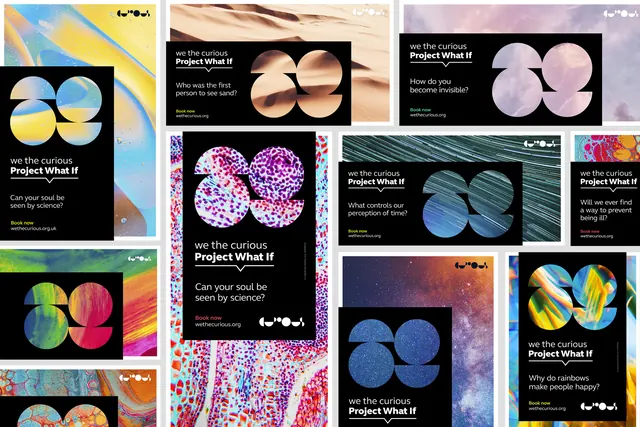
A tiled array of the exhibition's posters and banners in portrait, landscape and square ratios, showing one template flexing across every format.
More like this
See all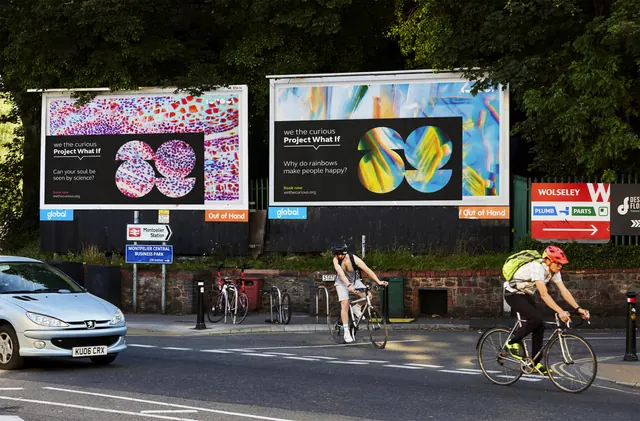
Summary
An overview board of roughly a dozen finished artworks from the campaign, packed into an irregular grid so the same black panel and monogram can be compared across tall, wide and square formats.
Visual description
Each tile is a self-contained poster on white gutters, slightly rotated as a group. Every one carries a full-bleed macro photograph, a black rectangle of copy and the four-circle monogram filled with that photograph, but the proportions change: tall portrait sheets stack the monogram above the lockup, wide landscape banners set the black panel left and the monogram right, and small squares crop the panel down to the lockup alone. Images include a yellow and blue oil slick, rippled desert sand, a pale violet cloud, magenta cellular micrographs, green star trails, orange bubble structures, a blue star field and iridescent crystal. Copy varies with the format from full questions ("Who was the first person to see sand?", "How do you become invisible?", "Will we ever find a way to prevent being ill?") to the lockup alone. The "Book now" line changes color per artwork, picking yellow, red, green or blue out of its photograph, and the small white pictogram floats in a free corner of each sheet.
Key takeaway
The template is defined by relationships rather than fixed coordinates: black panel, monogram and photograph keep their roles while their positions and sizes re-flow per ratio. That is what makes a single layout survive from a square social post to a six-sheet banner without redrawing it.
Reuse notes
The clearest single reference in this project for how to document a flexible campaign toolkit to a client or a production partner. Useful when pitching a system that has to cover many media at once. Note that at small sizes the monogram loses its image detail, so the smallest formats drop the photograph inside the mark and lean on the panel instead.
More like this

Keep what you find
A free account saves references to boards and can send you a weekly email of picks based on what you save.
To see every result, go Pro.