Preview image. Unlock full-res
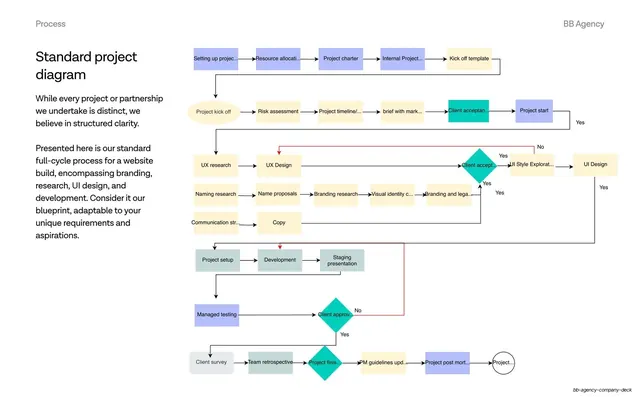
Full-width project-lifecycle flowchart with a left intro column, mapping a website build from kickoff through risk assessment, design, development, and post-mortem.
Summary
A single full-width flowchart, "Standard project diagram", that maps the agency's full-cycle website process end to end, with a short left intro framing it as an adaptable blueprint.
Visual description
White slide, 16:9, with a thin running header ("Process" left, "BB Agency" right). A narrow left column carries the headline "Standard project diagram" over two short grey paragraphs about structured clarity and an adaptable blueprint. The right four-fifths is a dense left-to-right, top-to-bottom flowchart of rounded rectangle steps in pale blue, cream, and sage, with rounded pill nodes for kickoff stages, teal decision diamonds (client acceptance and approval gates), and a terminal circle. Black arrows connect the sequence (Setting up project, Resource allocation, Project charter, Kick off, Project kick off, Risk assessment, UX research, UX Design, UI Design, Branding, Copy, Development, Staging, Managed testing, Client survey, Team retrospective, Project post mortem), with red arrows marking the "No" feedback loops back to earlier design and development stages. "Yes" and "No" labels sit beside each diamond.
Key takeaway
Documenting an entire delivery process as one honest, color-coded flowchart, including the rejection loops in red, signals operational maturity to a prospect. Anchoring the diagram with a calm left intro keeps a busy graphic from feeling overwhelming. Color-coding node families (planning, design, build) helps a viewer parse phases at a glance.
Reuse notes
Reach for this when a process, methodology, or how-we-work slide needs to prove rigor rather than just claim it. Best presented large or walked through live, since the node labels are small and truncated. The explicit feedback loops are the differentiator; keep them rather than drawing a tidy linear path.
From this deck: Standard project process flowchart
View deck
More like this
Keep what you find
A free account saves references to boards and can send you a weekly email of picks based on what you save.
To see every result, go Pro.