Preview image. Unlock full-res
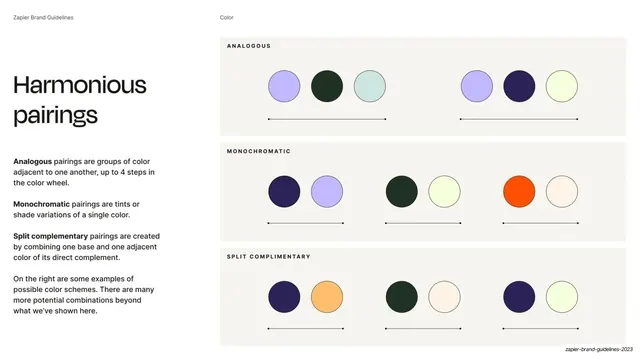
Pairing-rules slide explaining analogous, monochromatic, and split-complementary pairings at left, with three rows of color-dot examples on panels at right.
Summary
A color-pairing-rules slide: definitions of analogous, monochromatic, and split-complementary pairings at left, with three stacked panels of color-dot examples (one per rule) at right.
Visual description
Split layout: white left third over a pale off-white (#F2F1EC) right two-thirds. The running header reads "Zapier Brand Guidelines" and "Color". At left, an oversized two-line headline "Harmonious pairings" sits above Inter copy that bolds and defines "Analogous", "Monochromatic", and "Split complementary" pairings. At right, three stacked light panels, each labeled in small all-caps: ANALOGOUS (two example groups of three dots), MONOCHROMATIC (three example pairs of two dots each), and SPLIT COMPLIMENTARY (three example pairs). Each example sits above a thin line with end ticks, showing the colors as flat circles drawn from the brand palette.
Key takeaway
Documenting palette pairing rules with named, labeled example sets shown as plain color dots on tick-marked lines. The definitions on the left and the visual examples on the right map one-to-one, so the rule and its proof sit together.
Reuse notes
A reusable reference for teaching a team how to combine brand colors. The three-panel, dots-on-a-line layout reads instantly and scales to however many example pairings you provide. Pair with the next slide, which shows the same three rules in real campaign mockups.
From this deck: Harmonious color pairings
View deck











More like this


Keep what you find
A free account saves references to boards and can send you a weekly email of picks based on what you save.
To see every result, go Pro.