Preview image. Unlock full-res
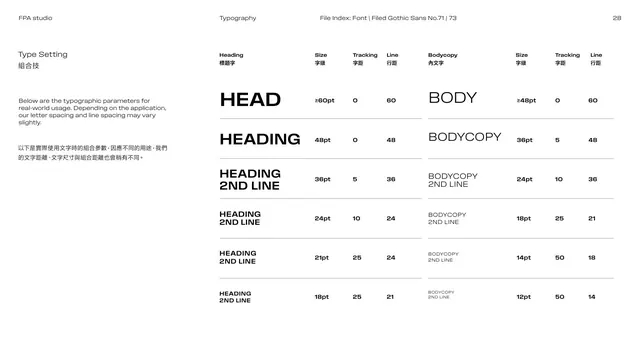
Type-scale page giving heading and bodycopy size, tracking and line-height values across six steps in two parallel tables.
Summary
The type-scale spec: two parallel tables, Heading and Bodycopy, each stepping down through six sizes with exact size, tracking and line-height values (for example Heading 60pt / 0 / 60, Bodycopy 48pt / 0 / 60).
Visual description
White page. A short note sits far-left in English over Chinese (parameters for real-world use, may vary). The body is two side-by-side tables. The left table, "Heading 標題字", shows specimen words (HEAD, HEADING, HEADING 2ND LINE) shrinking down six rows, each with columns for Size, Tracking and Line-height (60pt/0/60 down to 18pt/25/21). The right table, "Bodycopy 內文字", mirrors it (BODY, BODYCOPY shrinking) with its own values (48pt/0/60 down to 12pt/50/14). Hairline rules separate the rows. Black on white, tabular and dense.
Key takeaway
Pairing live shrinking specimens with exact size/tracking/line-height columns turns an abstract type scale into a directly applicable spec. Splitting heading and body into parallel tables keeps the two hierarchies legible at a glance.
Reuse notes
The practical heart of a typography section. Always give size, tracking and leading together. Reuse the specimen-plus-values table for any documented type scale; note how tracking increases as size decreases.
From this deck: Type setting, heading and body scale
View deck





More like this



Keep what you find
A free account saves references to boards and can send you a weekly email of picks based on what you save.
To see every result, go Pro.