Preview image. Unlock full-res
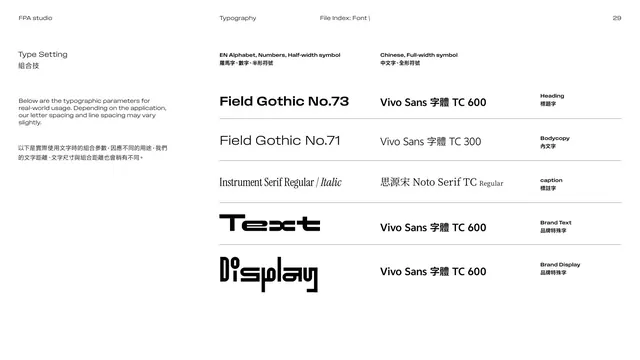
Type-pairing page mapping each Latin face to its Chinese counterpart and role across five rows, from heading to brand display.
Summary
The font-pairing matrix: five rows mapping each Latin typeface to its Chinese partner and intended role, from Field Gothic No.73 + Vivo Sans TC 600 (Heading) down to FPA Display + Vivo Sans TC 600 (Brand Display).
Visual description
White page. A short note sits far-left in English over Chinese. The body is a three-column table headed "EN Alphabet, Numbers, Half-width symbol" and "Chinese, Full-width symbol", with a role column on the right. Five rows pair: Field Gothic No.73 with Vivo Sans TC 600 (Heading); Field Gothic No.71 with Vivo Sans TC 300 (Bodycopy); Instrument Serif Regular / Italic with Noto Serif TC Regular (caption); FPA Text with Vivo Sans TC 600 (Brand Text); and FPA Display with Vivo Sans TC 600 (Brand Display). Each cell is set in its actual typeface, so the row shows the real pairing. Black on white.
Key takeaway
A pairing matrix that sets every cell in its own typeface lets you see the Latin and CJK faces side by side per role. Mapping each pair to a named role (Heading, Bodycopy, caption, Brand Text, Brand Display) removes ambiguity about which combination to use where.
Reuse notes
The definitive cross-script pairing reference for a bilingual system. Reuse this Latin-face / CJK-face / role table whenever both scripts must coexist; rendering cells in their live fonts is the detail that makes it useful.
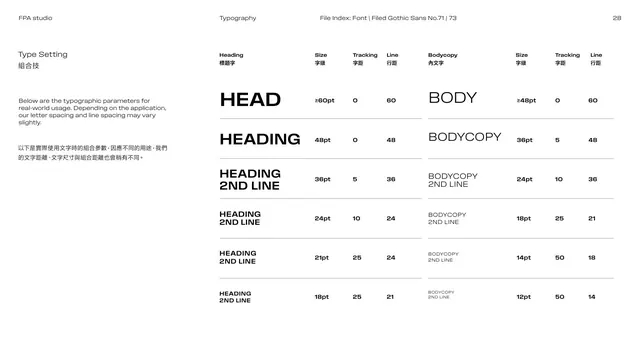
From this deck: Type setting, font pairing matrix
View deck
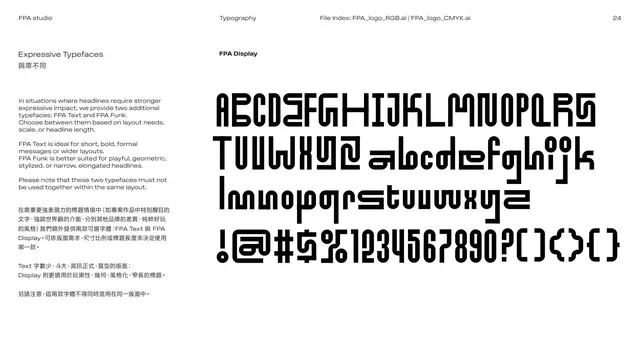
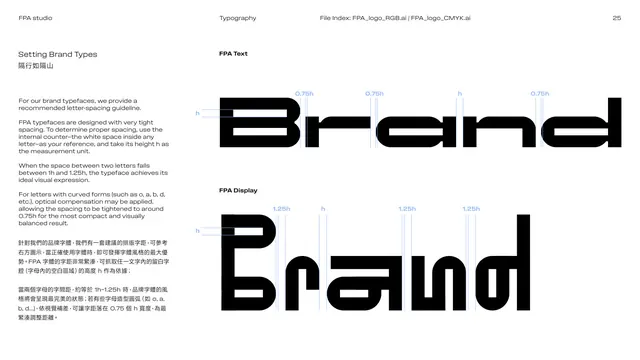
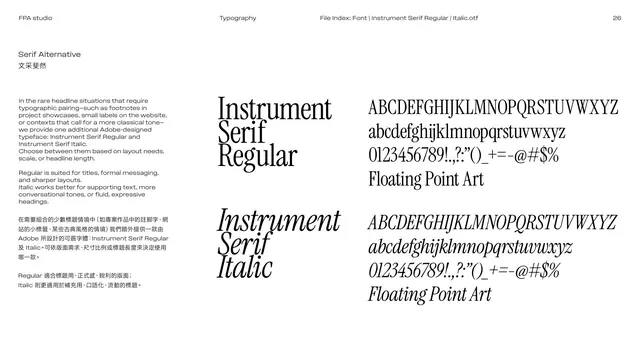
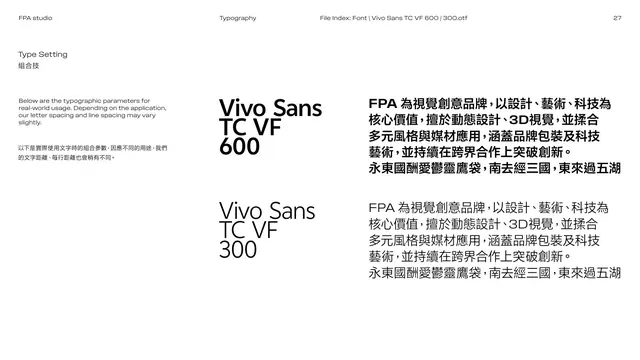
More like this
Keep what you find
A free account saves references to boards and can send you a weekly email of picks based on what you save.
To see every result, go Pro.