Preview image. Unlock full-res
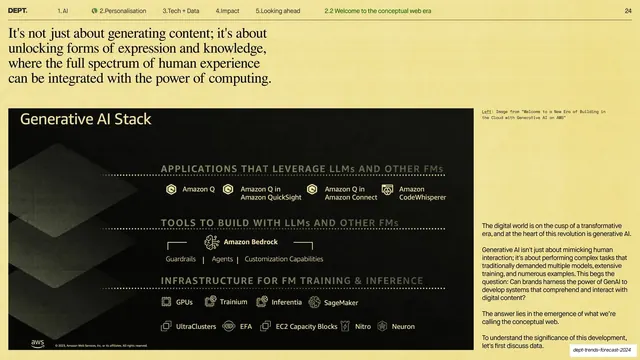
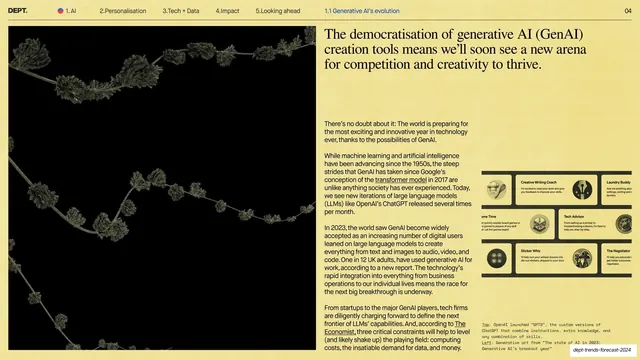
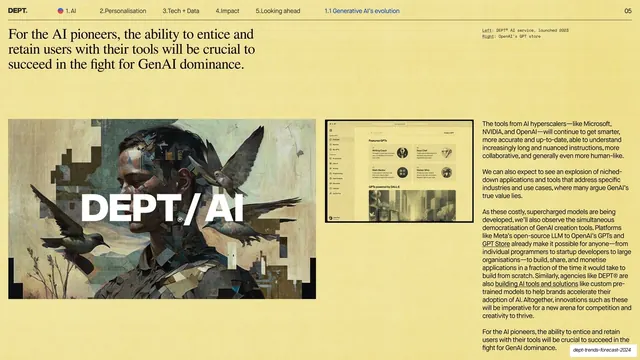
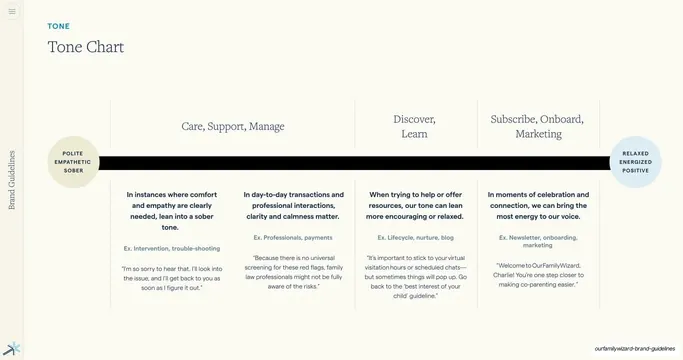
Pale-yellow slide with a serif headline and a large dark three-tier "Generative AI Stack" diagram of AWS services, plus a column of body copy at right.
Summary
A pale-yellow slide led by a serif headline, with a large dark "Generative AI Stack" diagram (an AWS / Amazon Bedrock layered service map) filling the left-center and a column of body copy at right.
Visual description
Warm pale-yellow ground with the standard header (2.Personalisation active, sub-section "2.2 Welcome to the conceptual web era", page 24). A four-line serif headline runs across the top ("It's not just about generating content; it's about unlocking forms of expression and knowledge..."). Below sits a wide near-black diagram panel titled "Generative AI Stack", organised into three labeled tiers separated by dotted rules: "Applications that leverage LLMs and other FMs" (Amazon Q, QuickSight, Connect, CodeWhisperer), "Tools to build with LLMs and other FMs" (Amazon Bedrock, with Guardrails / Agents / Customization branches), and "Infrastructure for FM training & inference" (GPUs, Trainium, Inferentia, SageMaker, etc.), each row with small line icons. An AWS logo and copyright sit bottom-left. The right column holds small dark sans-serif body copy and a monospace source caption.
Key takeaway
Embedding a real, structured technical stack diagram as the hero element while keeping the deck's serif-headline-top, copy-right frame intact. The dark diagram panel against the yellow ground reads as a self-contained exhibit.
Reuse notes
Best for explaining a layered system or architecture inside a trends or strategy report. The borrowed AWS diagram is dense; pair it with a short headline that frames why it matters. Keep technical exhibits on their own dark panel so they do not fight the warm background.
From this deck: Generative AI stack (AWS Bedrock diagram + body)
View deck



More like this
Keep what you find
A free account saves references to boards and can send you a weekly email of picks based on what you save.
To see every result, go Pro.