Preview image. Unlock full-res
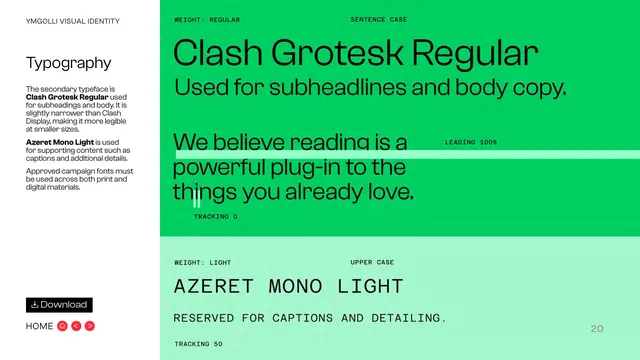
Green type specimen for the secondary fonts, showing Clash Grotesk Regular for body and Azeret Mono Light for captions with leading and tracking notes.
Summary
The secondary-type specimen: Clash Grotesk Regular for subheads and body and Azeret Mono Light for captions, shown on two tones of green with explicit leading and tracking labels.
Visual description
Left sidebar (white) carries the "Typography" title and notes: Clash Grotesk Regular is the secondary face for subheadings and body, slightly narrower than Clash Display for legibility at small sizes; Azeret Mono Light is used for supporting content like captions and detailing; approved campaign fonts must be used across print and digital. The right area is a stacked green specimen. The upper, bright green block shows "Clash Grotesk Regular" and "Used for subheadlines and body copy." plus a large setting "We believe reading is a powerful plug-in to the things you already love." annotated "LEADING 100%" and "TRACKING 0". The lower, mint block shows "AZERET MONO LIGHT" in all-caps with "RESERVED FOR CAPTIONS AND DETAILING." and "TRACKING 50", labelled WEIGHT LIGHT and UPPER CASE. "Download" above "HOME" bottom-left; page "20" bottom-right.
Key takeaway
Annotating live settings with their actual leading and tracking values turns a specimen into a usable spec. Pairing a grotesk body face with an all-caps mono caption face gives a technical, campaign-ready voice.
Reuse notes
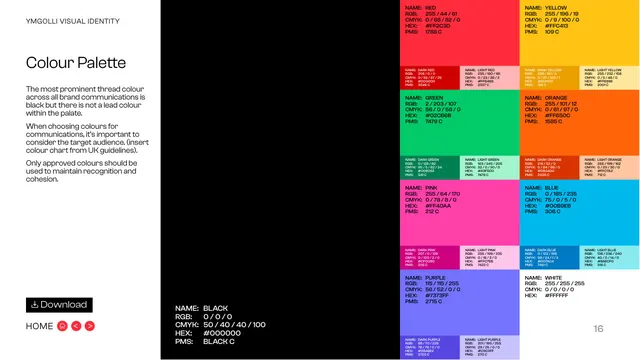
The reference page for the support type; reuse the colour-block specimen with inline leading/tracking callouts. The three-tier headline/body/caption stack (Display, Grotesk, Mono) is a clean model for a complete type system.
From this deck: Typography, Clash Grotesk and Azeret Mono
View deck
More like this

Keep what you find
A free account saves references to boards and can send you a weekly email of picks based on what you save.
To see every result, go Pro.