Preview image. Unlock full-res
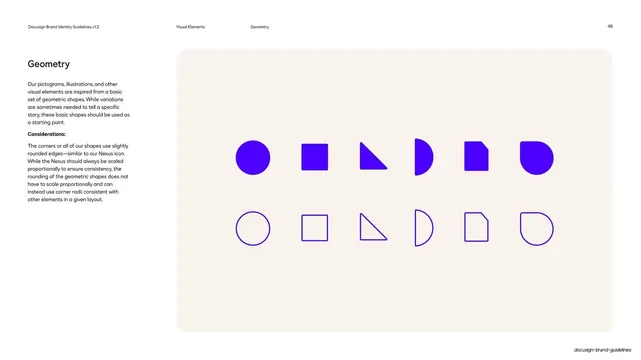
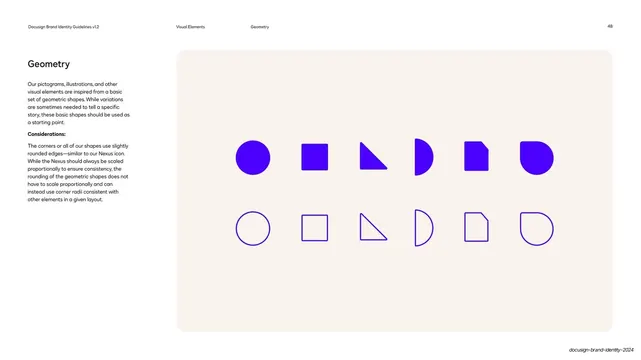
Light page defining the brand's six core geometric shapes, shown twice on a cream panel as a solid cobalt row above an outlined row.
Summary
The geometry page: it establishes the six core shapes that all pictograms and illustrations are built from, shown as a solid cobalt row above a matching outlined row.
Visual description
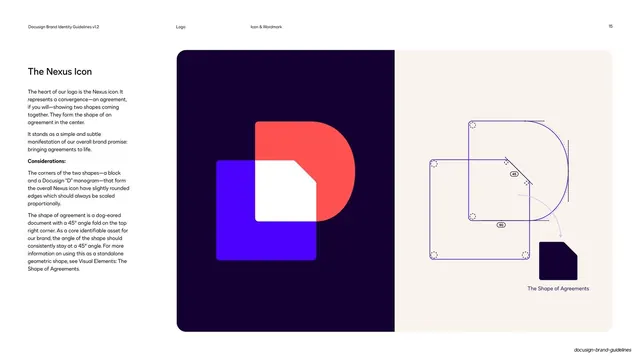
White background, standard header ("Visual Elements" / "Geometry", page "48"). The left column holds "Geometry", a short paragraph, and a "Considerations" note about slightly rounded corners borrowed from the Nexus icon. The right two-thirds is a large cream rounded panel containing two aligned rows of six shapes each. The top row is solid cobalt: a circle, a square, a right triangle, a half-circle (D shape), a dog-eared document, and a circle with one flat-cut side. The bottom row repeats the identical six as thin cobalt outlines. Each shape carries the same gently rounded corners, signaling the family relationship; the dog-eared document ties back to the brand's Nexus motif.
Key takeaway
Defining a small fixed kit of primitive shapes and showing each in both solid and outline form, so the building blocks of the whole visual language are declared up front. Carrying one shared corner-rounding across every primitive (and slipping the brand's signature dog-eared document into the set) makes everything built from them feel on-brand by default.
Reuse notes
A foundational page for any system with a geometric illustration or icon language. Establishing the primitives here lets later pictogram and pattern pages reference them instead of redefining shapes. The solid-plus-outline pairing previews the two fill modes used downstream.
From this deck: Core geometric shapes
View deck



















































More like this





Keep what you find
A free account saves references to boards and can send you a weekly email of picks based on what you save.
To see every result, go Pro.