Preview image. Unlock full-res
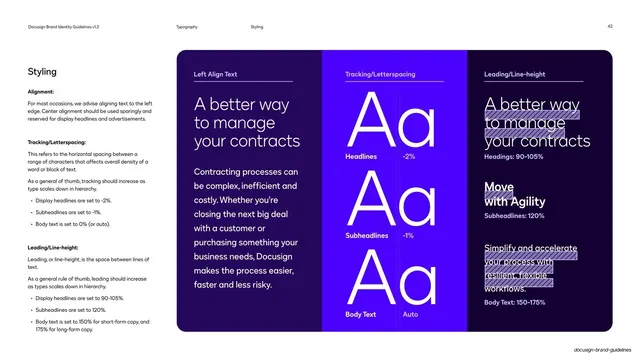
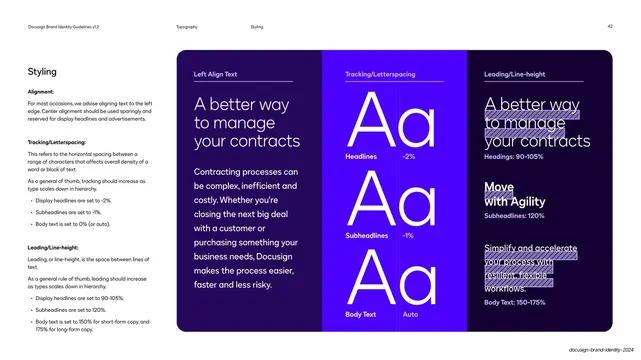
Dark three-column page covering text styling rules: left alignment, tracking values per type role, and leading percentages, each with a worked DS Indigo example.
Summary
The styling page: three dark columns covering alignment, tracking, and leading, each rule shown with a worked DS Indigo example and the exact values per type role.
Visual description
White background, standard header ("Typography" / "Styling", page "42"). The left column holds "Styling" with Alignment, Tracking/Letterspacing, and Leading/Line-height notes, each with a small bulleted value list. The right two-thirds is a deep-violet panel divided into three vertical columns by hairline rules. Column one, "Left Align Text", sets the headline "A better way to manage your contracts" left-aligned over a body paragraph. Column two, "Tracking/Letterspacing", stacks three oversized "Aa" pairs labeled Headlines −2%, Subheadlines −1%, and Body Text Auto. Column three, "Leading/Line-height", repeats the headline/subhead/body example with lilac highlight bars marking the line spacing and labels Headings 90-105%, Subheadlines 120%, Body Text 150-175%. All type is white or lilac on violet.
Key takeaway
Splitting three distinct styling rules into three parallel columns, each carrying both the numeric spec and a live demonstration, so a designer can read the rule and see its result side by side. Using oversized "Aa" pairs to make tracking differences visible at a glance, and highlight bars to make leading literally measurable.
Reuse notes
A compact, reusable way to document the mechanical type rules (alignment, tracking, leading) on a single page. The three-column structure scales to other paired rule sets. The highlighted-line leading demo is a clean trick for showing spacing that is otherwise hard to see.
From this deck: Type styling alignment tracking leading
View deck








More like this



Keep what you find
A free account saves references to boards and can send you a weekly email of picks based on what you save.
To see every result, go Pro.