Preview image. Unlock full-res
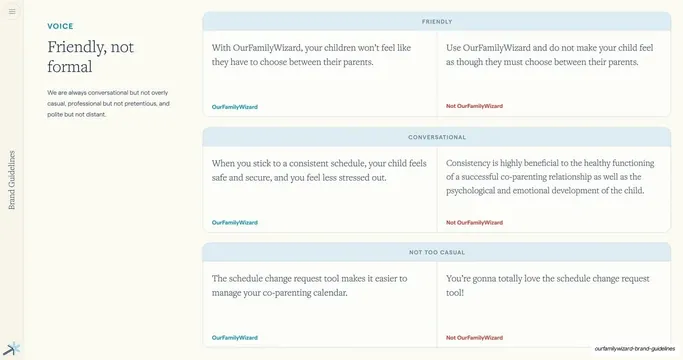
Cream voice-detail slide contrasting on-brand and off-brand copy across three labeled rows of paired do and do-not example cards.
Summary
A voice-detail slide contrasting on-brand and off-brand writing: a definition at left and three category rows on the right, each pairing an "OurFamilyWizard" example against a "Not OurFamilyWizard" one.
Visual description
Warm cream (#FAF6EC) ground. The left column carries a teal "VOICE" eyebrow, a two-line serif "Friendly, not formal" subhead, and a short grey-navy sans paragraph. The right two-thirds holds three stacked rounded cards, each topped by a powder-blue all-caps header band (FRIENDLY, CONVERSATIONAL, NOT TOO CASUAL) and split into two columns. Each column shows a serif example sentence and a small caption: the left captioned "OurFamilyWizard" in teal, the right captioned "Not OurFamilyWizard" in red. The pairings contrast a warm, plain version against a stiff or over-casual one. The left edge carries the vertical "Brand Guidelines" label, the spark mark bottom-left, and a circular menu icon top-left.
Key takeaway
The do / do-not pairing with color-coded captions (teal for right, red for wrong) under a neutral category header. Stacking three categories lets one slide cover several failure modes (too formal, too casual) at once while staying scannable.
Reuse notes
A clear teaching pattern for voice, copy, or any guideline with right-and-wrong examples. The teal/red caption coding is the key signal and should stay consistent wherever do/do-not appears in the deck. Keep paired examples roughly equal in length so the comparison reads cleanly.
From this deck: Voice, Friendly not formal comparison
View deck





More like this


Keep what you find
A free account saves references to boards and can send you a weekly email of picks based on what you save.
To see every result, go Pro.