
Preview image. Unlock full-res
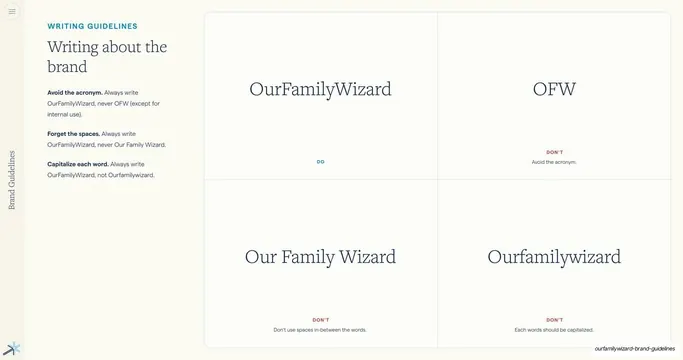
Grammar-rule slide with guidance at left and four stacked serif example sentences on the right, two marked DO and two DON'T, with key words colored teal or red.
Summary
A grammar-rule slide showing how to treat feature names as singular: the rule on the left, and four stacked serif example sentences on the right, two labeled DO and two DON'T, with the key verb colored teal (correct) or red (wrong).
Visual description
Cream background. The left column has a teal "WRITING GUIDELINES" eyebrow, a two-line navy serif heading ("Treat all top-level features as singular"), and a short gray sans rule. The right two-thirds is a tall bordered panel of four rows split by hairlines; each row carries a small teal "DO" or red "DON'T" label and a large navy serif sentence, with the contrasting word set in italic and colored teal ("Calls keeps," "Messages encourages") or red ("Calls keep," "Messages encourage"). The vertical "Brand Guidelines" label and blue Spark symbol sit at the left edge and bottom-left.
Key takeaway
Coloring just the single word that makes a sentence right or wrong (teal versus red, italicized) focuses attention on the exact decision point, while the rest of the sentence stays neutral navy. The paired DO/DON'T rows make the same sentence comparable line for line.
Reuse notes
Excellent for grammar, capitalization, or phrasing rules where the difference is one word. The color-on-keyword technique only works if the contrast words are short and obvious; for longer differences, fall back to bold or underline.
From this deck: Treat features as singular do/don't examples
View deck












































More like this







Keep what you find
A free account saves references to boards and can send you a weekly email of picks based on what you save.
To see every result, go Pro.