Preview image. Unlock full-res
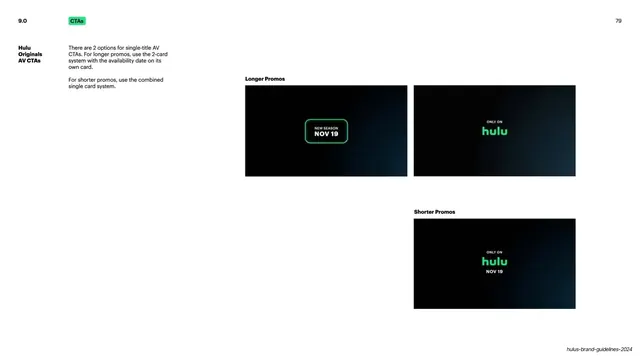
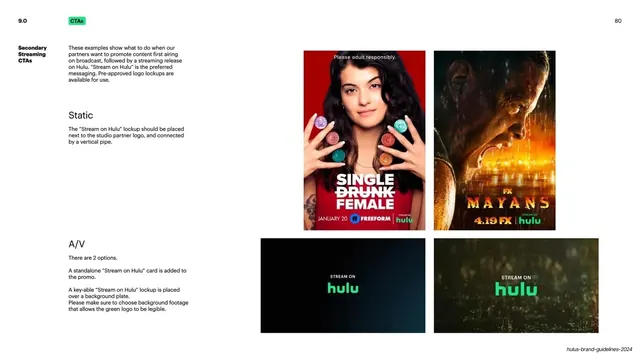
Dark slide presenting two AV CTA systems (a two-card sequence for longer promos and a combined single card for shorter promos) as near-black video frames.
Summary
The two ways the AV (video) end-card CTA can be built: a two-card sequence for longer promos and a single combined card for shorter ones.
Visual description
Near-black background. Header reads "9.0", a green "CTAs" pill, and "79" top-right. A bold white "Hulu Originals AV CTAs" label and short text at far left explain the two options. The upper right is labeled "Longer Promos" and shows two near-black video frames side by side: the first holds a green-outlined rounded badge reading "NEW SEASON NOV 19", the second a small "ONLY ON" line above the green "hulu" wordmark, both with a soft radial glow. Lower right is labeled "Shorter Promos" and shows a single near-black frame combining "ONLY ON", the green "hulu" wordmark, and "NOV 19" stacked. A running footer sits bottom-right.
Key takeaway
Documenting a motion end-card as a small set of still frames, and giving long-form and short-form promos different card counts (two-beat versus one combined card). The faint radial glow behind the green mark on a black field is a quiet way to make the logo sit in space.
Reuse notes
A useful pattern for governing video bumpers and end-cards in a static guideline, where the rule is really about sequence and pacing. The long/short split maps directly to pre-roll versus bumper ad lengths.
From this deck: Hulu Originals AV CTA options
View deck




























































More like this








Keep what you find
A free account saves references to boards and can send you a weekly email of picks based on what you save.
To see every result, go Pro.