Preview image. Unlock full-res
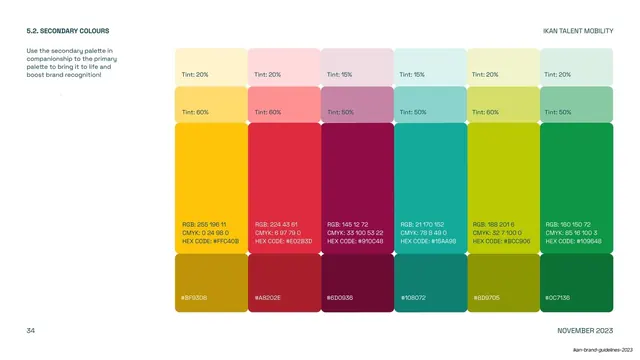
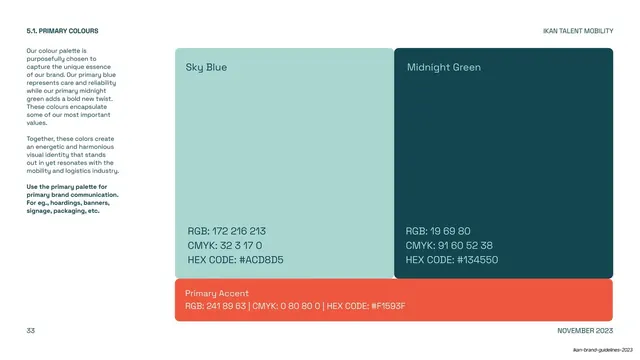
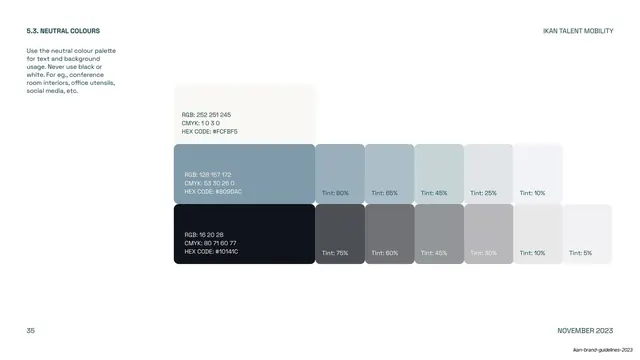
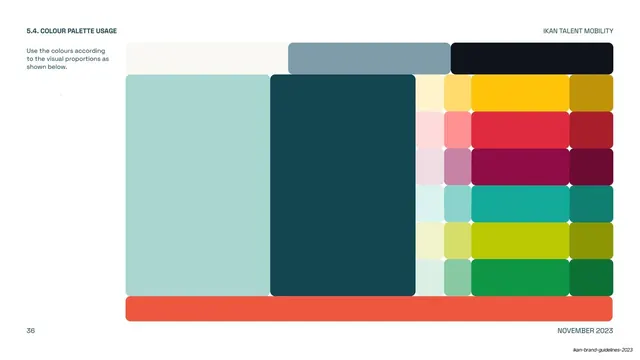
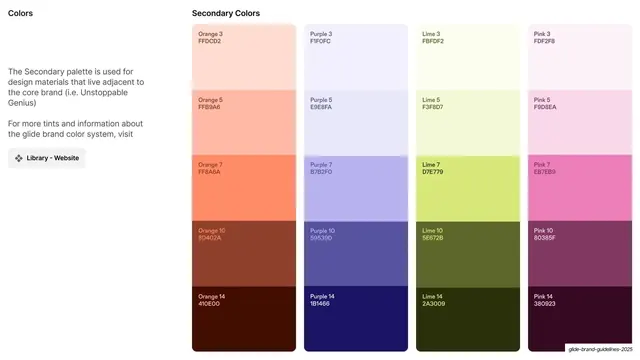
Six-column secondary palette, yellow, red, magenta, teal, lime and green, each shown as a base color with tint steps and a darker shade, with HEX codes.
Summary
The secondary palette page: six vertical color columns (yellow, coral red, magenta, teal, lime, green) each built from light tint steps down to the saturated base and a darker shade, every step carrying its values.
Visual description
White page, utility frame ("5.2. SECONDARY COLOURS", "IKAN TALENT MOBILITY", page "34", "NOVEMBER 2023"); a one-line instruction sits in the left margin. The body is a six-column grid of rounded stacked blocks. Each column runs top to bottom from a pale "Tint: 20%" (or 15%) through a "Tint: 60%" (or 50%) to the full-strength base (carrying "RGB / CMYK / HEX CODE") and finally a darker shade block with its own HEX. The six base hues are a golden yellow (#FFC40B), coral red (#E02B3D), magenta (#910C48), teal (#15AA98), lime (#BCC906) and green (#109648).
Key takeaway
Documenting each secondary color as a full vertical tint-and-shade ramp, not just a single chip, hands designers a ready-made tonal range and keeps the expanded palette systematic rather than a random rainbow.
Reuse notes
A thorough secondary-palette reference for a brand that needs a wide, lively accent range (here to flex across mobility/logistics communications). The column-as-ramp format scales to any number of hues; keep the tint percentages consistent across columns as shown.
From this deck: IKAN secondary colours with tints
View deck










More like this
Keep what you find
A free account saves references to boards and can send you a weekly email of picks based on what you save.
To see every result, go Pro.