Preview image. Unlock full-res
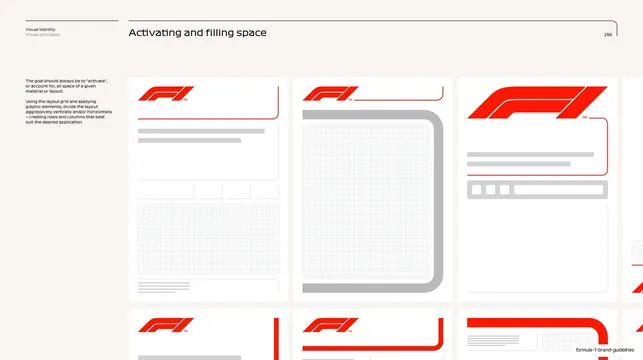
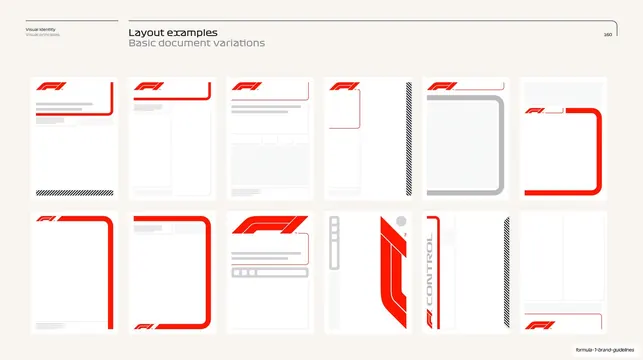
Cream page tiling twelve portrait document templates in two rows, each a white page with the red F1 bracket framing placeholder content in a different arrangement.
Summary
A specimen wall of twelve basic document templates, each a white portrait page where the red F1 bracket and grey placeholder blocks sit in a slightly different position.
Visual description
Warm off-white background, standard hooked-hairline header with "Layout examples / Basic document variations". Twelve identical-size portrait cards are laid out in two rows of six. Each card is a white page carrying the small F1 mark top-left and the signature thick line that runs down and brackets a corner, here rendered in red, grey, or black. Placeholder content is abstracted as grey bars, light dotted pattern fills, and outlined boxes, arranged differently per card: some lead with a wide headline band, some split into columns, some drop the bracket to the bottom, one places a hatched stripe down the side, one centers the F1 mark large. The effect is a catalog of how one framing device reflows across many page structures.
Key takeaway
Presenting a layout system as a 2x6 specimen wall, where only the position of one consistent bracket and the placeholder blocks change. It communicates flexibility and rules simultaneously, with zero real copy.
Reuse notes
A clean way to show template ranges in any identity or document-system guideline. The repeat-card grid is reusable for icon sets, cover variations, or social-format libraries. Keep the framing device truly constant across cards or the "system" reading breaks.
From this deck: Basic document variations template library
View deck