Preview image. Unlock full-res
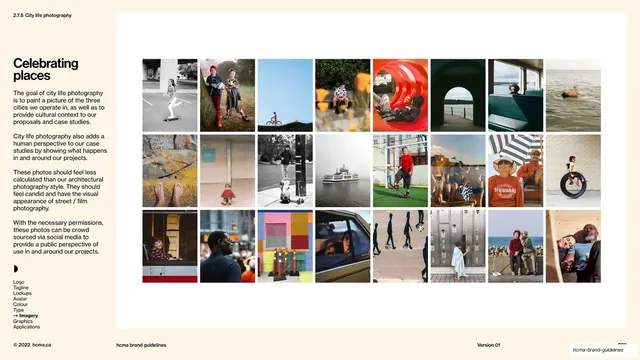
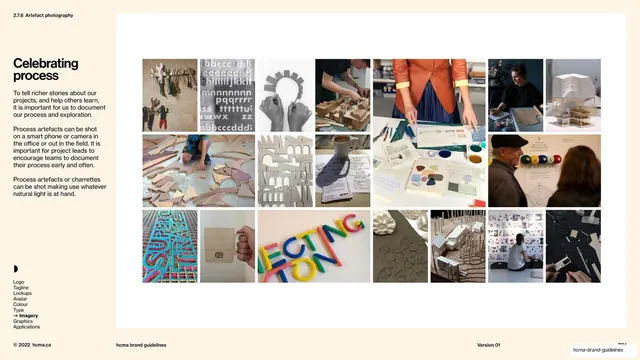
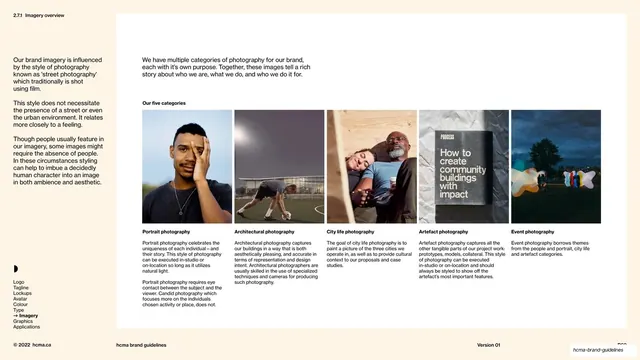
The photography overview, a five-up row of category thumbnails (portrait, architectural, city life, artefact, event) each captioned with how that category is shot.
Summary
The photography overview page: a single row of five example images, one per category (portrait, architectural, city life, artefact, event), each with a caption defining how that kind of image should be shot.
Visual description
This spread drops the cream rail for a clean white page. The thin left rail carries "2.7.1 Imagery overview", a short rationale (the brand's imagery is influenced by street photography, capturing real human character), the half-circle glyph and the contents list with "Imagery" highlighted. A lead line at top reads about multiple photography categories. Below, under "Our five categories", sit five evenly spaced photographs in a row: a close portrait of a young man, a footballer mid-stride on a pitch, two people resting together (city life), a styled shot of the firm's "Process" book (artefact), and a dusk group at an event with abstract light forms. Each image has a bold category label and a paragraph beneath explaining its intent and treatment. A faint footer runs along the bottom.
Key takeaway
Defining a photography style as a fixed set of named categories, each anchored by one exemplar image and a short shooting brief, gives commissioners and photographers a shared vocabulary. The shift from the cream system pages to a clean white imagery section quietly signals "this chapter is about pictures".
Reuse notes
A clear overview layout for the photography section of any brand book; the five-up category row scales to however many genres a brand shoots. Each thumbnail then expands into its own deep-dive page later in the section. Needs strong, on-brand example photography to set the standard credibly.
From this deck: HCMA imagery overview, five photography categories
View deck