Preview image. Unlock full-res
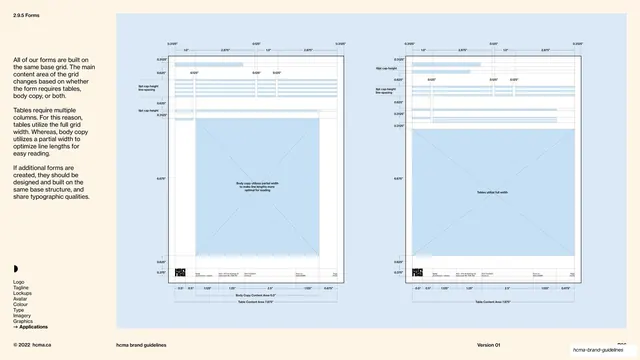
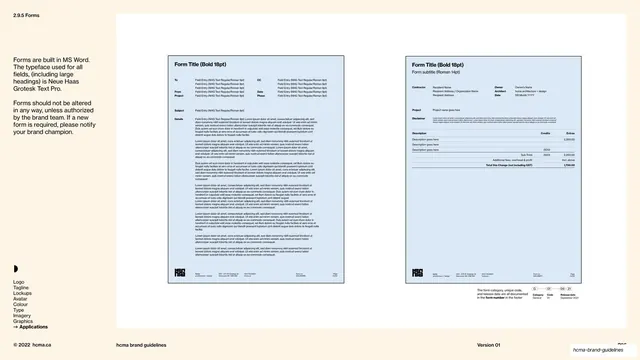
Forms application page showing two annotated MS Word form templates with labelled type sizes and a footer coding system on a pale blue field.
Summary
A forms page presenting two Word-built form templates side by side, each field and heading annotated with its exact typeface and point size, plus a footer scheme that encodes form category, code and release date.
Visual description
Cream page, left rail intact: section label "2.9.5 Forms" top-left, two copy blocks stating forms are built in MS Word in Neue Haas Grotesk Text Pro and must not be altered without brand-team authorization; crescent mark and vertical Applications nav lower-left; hairline footer below. The right field is a white panel holding two portrait form sheets. The left sheet is a memo-style form headed "Form Title (Bold 18pt)" with To / From / Project and CC / Date / Phase field groups, each line labelled in tiny grey type with its style ("Field Entry NHG Text Regular/Roman 9pt"), then a long Subject/Details block of greyed dummy paragraphs, the black square logo and a footer line at the foot. The right sheet is a change-order form with "Form Title (Bold 18pt)" and "Form subtitle (Roman 14pt)", Contractor / Owner / Architect blocks, a Description table with Credits and Extras columns, Sub-Total and "Total this Change" rows, and a footnoted footer reading the form category, unique code and release date with circled "G / 01 / 09 / 21" tokens labelled Category, Code, Release date.
Key takeaway
Annotating every field of a live document template with its exact font and point size, so the guideline is also the build spec. Encoding document metadata into a structured footer (category, code, release date) gives a large organization a versioning system baked into the artefact itself.
Reuse notes
Directly applicable to any brand that hands Word or InDesign templates to internal teams and needs them to stay typographically consistent. The labelled-size overlay is the key move for non-designer authors. Dense and utilitarian by nature; reserve it for the forms or document-systems chapter rather than a hero page.
From this deck: HCMA forms templates page
View deck