Preview image. Unlock full-res
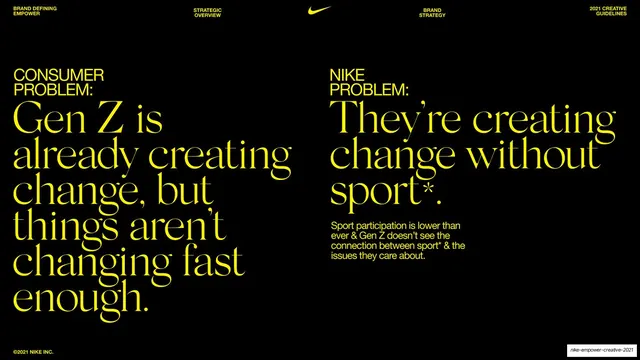
Black two-column problem slide pairing a consumer problem and a Nike problem, each set as a large yellow serif statement with a short sans support line.
Summary
A two-column problem statement: a "Consumer Problem" and a "Nike Problem" sit side by side, each a large yellow serif line on black with a small label above and a brief sans support line.
Visual description
Near-black full bleed with the standard running header and centered yellow swoosh. Two columns divide the slide. Each opens with a small all-caps yellow sans label, "CONSUMER PROBLEM:" on the left and "NIKE PROBLEM:" on the right. Below each, a large high-contrast serif statement in yellow: left, "Gen Z is already creating change, but things aren't changing fast enough."; right, "They're creating change without sport*." The right column adds three lines of smaller yellow sans support copy under its statement; the left column's serif runs longer and fills its half. Footer "©2021 NIKE INC." bottom-left.
Key takeaway
Framing a problem as a balanced two-column comparison, one consumer-side and one brand-side, each led by a serif statement and a tiny label. The asterisk on "sport*" hints at a defined term elsewhere in the deck, a neat way to carry a footnoted concept through a system.
Reuse notes
A clean structure for problem or tension slides that need to show two sides at once. The serif-for-statement, sans-for-support, label-on-top pattern is reusable across the deck's narrative pages. Keep the two columns roughly balanced in length so neither side dominates.
From this deck: Consumer and Nike problem
View deck















































































More like this



Keep what you find
A free account saves references to boards and can send you a weekly email of picks based on what you save.
To see every result, go Pro.